Domain Authority Metrics Explained: DR, DA, TF and CF
Domain Authority Metrics Explained: DR, DA, TF and CF
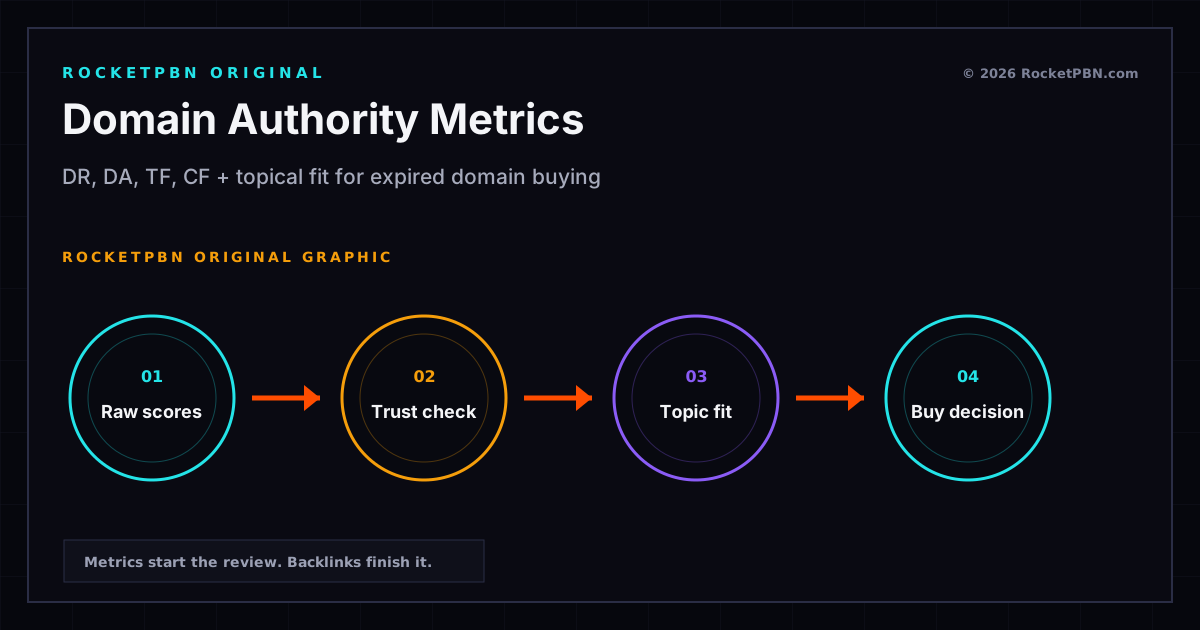
Domain authority metrics are third-party shortcuts for reading backlink strength. They are useful when buying expired domains, comparing competitors, or qualifying link prospects, but they are not Google scores and they do not replace backlink review. Treat them as triage signals, not final verdicts.
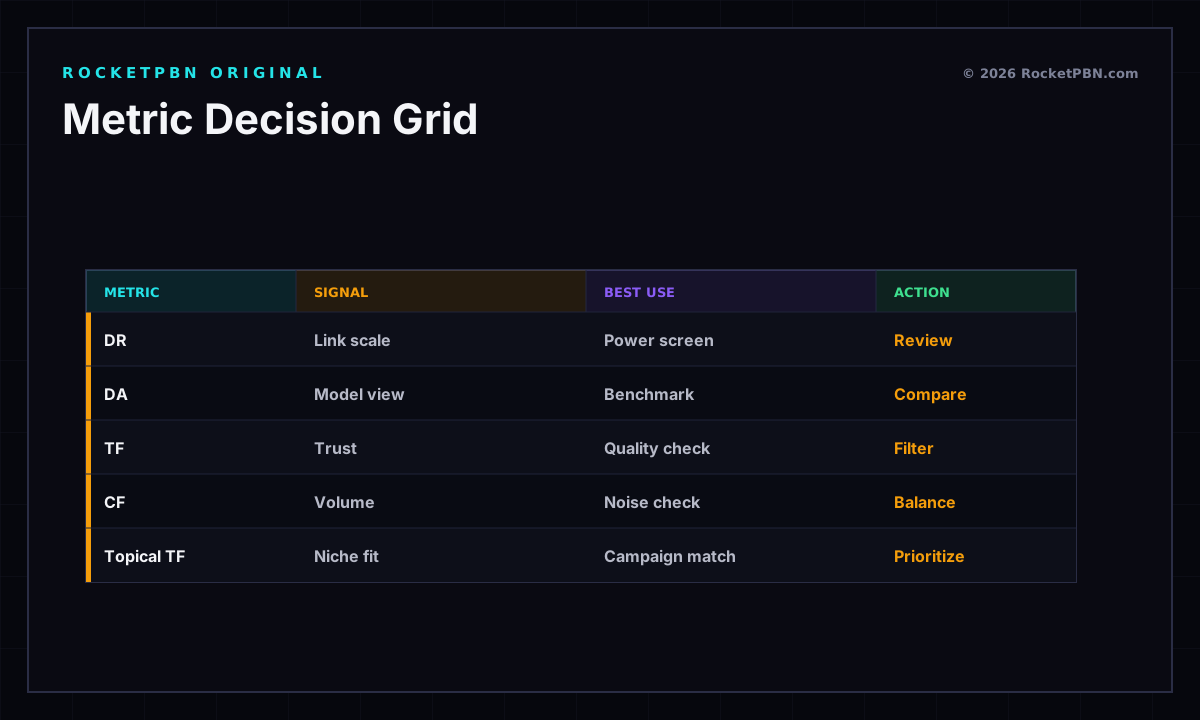
The main metrics operators compare are Ahrefs Domain Rating, Moz Domain Authority, Majestic Trust Flow, Majestic Citation Flow, Topical Trust Flow, referring domains, anchor profile, organic traffic, and spam signals. Each metric answers a different question. DR estimates link equity scale. DA estimates relative ranking strength from Moz's model. TF measures trust quality. CF measures link volume. Topical Trust Flow adds niche relevance.
This guide explains what each metric means, where it breaks, and how to combine them into a buying framework for expired domains, PBN assets, iGaming domains, and agency link building. The practical rule is simple: never buy on one number. Buy only when authority, trust, relevance, history, and price all tell the same story.
What Are Domain Authority Metrics and Why Do SEOs Use Them?
Domain authority metrics are proprietary scores from SEO tools that estimate the strength, trust, or ranking potential of a domain or URL. SEOs use them because Google does not publish a visible authority score, so third-party tools create comparative proxies from backlink data.
Why These Metrics Exist
Google's public documentation confirms that links remain part of how search systems understand pages, but Google also uses many other signals. Because the real scoring system is not visible, SEO tools built their own authority metrics from crawled link graphs.
That makes DR, DA, TF, and CF useful for comparison. They help operators sort large lists of domains before spending time on manual review. They are especially useful in expired-domain sourcing, where thousands of candidates must be reduced to a short buy list.
What They Can and Cannot Tell You
Metrics can show whether a domain has link strength, trust signals, referring-domain volume, or topical relevance. They cannot prove that the domain is indexed, clean, safe to rebuild, or worth the asking price.
| Metric family | Useful for | Cannot prove |
|---|---|---|
| DR / DA | broad authority screening | clean history |
| TF / CF | trust vs volume balance | topical fit alone |
| Topical TF | niche relevance | commercial value |
| Referring domains | link base size | link quality |
| Spam signals | risk screening | final penalty status |
Why One Number Is Dangerous
A DR 55 domain can be weak if the links are sitewide, irrelevant, or recently injected. A DA 40 domain can be useful if it has clean history and strong topical links. A TF 25 domain can still fail if Wayback shows a hard niche flip.
The score starts the review. The backlink profile finishes it.
How Does Ahrefs Domain Rating Work?
Ahrefs Domain Rating measures the relative strength of a website's backlink profile on a 0-100 scale. It is calculated from linking domains and how those domains distribute link equity, making it useful for link power screening but weak as a standalone quality signal.
What DR Measures
Ahrefs describes DR as a measure of a domain's backlink-profile strength compared with other sites in its database. Stronger linking domains can pass more value, but that value is divided across the domains they link to. A high-DR page that links to many domains may pass less weight than expected.
This matters for expired domains because DR can look impressive even when the underlying referring domains are weak, irrelevant, or spread thin across too many outbound targets.
How To Read DR Tiers
Use DR as a first-pass filter, not as a purchase decision.
| DR range | Typical read | Expired-domain use |
|---|---|---|
| 0-19 | weak or new link profile | usually reject unless brand value exists |
| 20-34 | small authority base | tier 2, local, testing |
| 35-49 | useful authority | tier 1 candidate with clean TF/history |
| 50-64 | strong authority | premium review required |
| 65+ | rare and expensive | inspect every top link manually |
DR Red Flags
DR becomes suspicious when referring-domain count is low, traffic is zero, anchors are commercial, or Ahrefs shows link spikes without matching historical content. A domain with DR 50 and 12 real referring domains is not the same as a domain with DR 50 and 90 clean editorial referring domains.
Use DR to ask: "Is there enough link equity to justify deeper review?"
How Does Moz Domain Authority Differ From DR?
Moz Domain Authority predicts how likely a domain is to rank relative to other domains in Moz's index. Unlike DR, which focuses on backlink profile strength, DA uses a machine-learning model built from Moz link data and ranking correlation signals.
What DA Measures
Moz describes Domain Authority as a 0-100 score designed to predict ranking potential. It uses a machine-learning model and multiple link-related signals. The exact weights are proprietary, so DA should be read as a comparative estimate, not a transparent formula.
DA is useful when comparing domains inside the same niche. It is less useful when comparing unrelated markets, because a DA 35 local service site and a DA 35 national publisher do not face the same competitive environment.
DA vs DR
DA and DR often disagree because Moz and Ahrefs crawl different parts of the web and model authority differently.
| Signal | Ahrefs DR | Moz DA |
|---|---|---|
| Tool owner | Ahrefs | Moz |
| Main purpose | backlink profile strength | ranking potential estimate |
| Scale | 0-100 relative | 0-100 relative |
| Best use | link equity screening | competitor benchmarking |
| Weakness | can inflate from link volume | can lag or differ by index |
When DA Is Useful
DA helps when the buyer wants a second opinion on authority. If DR is high but DA is very low, inspect the link profile for artificial patterns. If DA and DR both look moderate but TF and topical fit are strong, the domain may still be valuable.
Use DA to ask: "Does another link index agree that this domain has authority?"
What Do Trust Flow and Citation Flow Actually Tell You?
Trust Flow measures backlink quality based on proximity to trusted sources, while Citation Flow measures link quantity or link influence. The gap between TF and CF is often more useful than either number alone because it shows whether link volume is supported by trust.
Trust Flow
Majestic describes Trust Flow as a score from 0 to 100 that models link quality. It starts from a trusted seed set and measures how link equity flows through the web. Higher Trust Flow is harder to achieve than raw link volume, which is why many expired-domain buyers prioritize it.
For PBN buying, TF below 10 is usually weak. TF 15+ can be useful. TF 20+ deserves review if the domain also has topical match and clean history.
Citation Flow
Citation Flow is the volume side of Majestic's flow metrics. It estimates how much link influence points at a URL or domain, regardless of whether that influence is trusted. High CF with low TF often means the domain has link volume without quality.
That pattern is common on spammed expired domains. The domain looks powerful at first glance, but the trust layer does not support the link volume.
TF:CF Ratio
The TF:CF ratio is a fast quality check.
| TF:CF ratio | Read | Action |
|---|---|---|
| 0.70+ | strong trust balance | inspect topical fit and history |
| 0.50-0.69 | usable range | candidate if anchors are clean |
| 0.30-0.49 | noisy | manual backlink review required |
| below 0.30 | weak trust balance | reject unless exceptional reason |
Use TF and CF to ask: "Is link volume supported by trust?"
Why Is Topical Trust Flow Often More Important Than DA or DR?
Topical Trust Flow is often more important for expired-domain buying because it shows what topic the domain is trusted for. A domain with lower authority but matching topical trust can outperform a higher-DR domain with irrelevant history.
What Topical Trust Flow Adds
Topical Trust Flow categorizes the trust of a page, subdomain, or root domain by topic. Majestic's documentation explains that influence can be measured at multiple levels and across topical categories, not only as one global authority score.
That makes it valuable for niche campaigns. A sports domain with Sports and Recreation trust is more defensible for betting content than a higher-DR lifestyle blog with scattered categories.
Topic Match Beats Headline Score
For iGaming, gambling, sports, poker, finance, and affiliate campaigns, topical alignment reduces rebuild friction. The old content, backlinks, anchors, and new content can tell one consistent story.
| Domain profile | DR | Topical fit | Better use |
|---|---|---|---|
| Sports news history | 38 | strong Sports | sportsbook PBN |
| Generic lifestyle blog | 52 | weak match | tier 2 or reject |
| Poker strategy archive | 31 | strong Games | poker affiliate |
| Local business archive | 45 | unrelated | avoid direct money links |
When Topical Data Is Misleading
Topical Trust Flow can be noisy on domains with mixed histories, redirects, or multiple niche flips. Always verify the dominant topic against Wayback, anchors, top backlinks, and indexed traces.
For a deeper breakdown, read What Is Topical Trust Flow?.
Which Metrics Should You Use Before Buying an Expired Domain?
Use DR for link equity scale, DA for model agreement, TF and TF:CF for trust quality, Topical Trust Flow for niche relevance, referring domains for link diversity, and Wayback for historical continuity. A domain passes only when these signals agree.
Buying Benchmarks
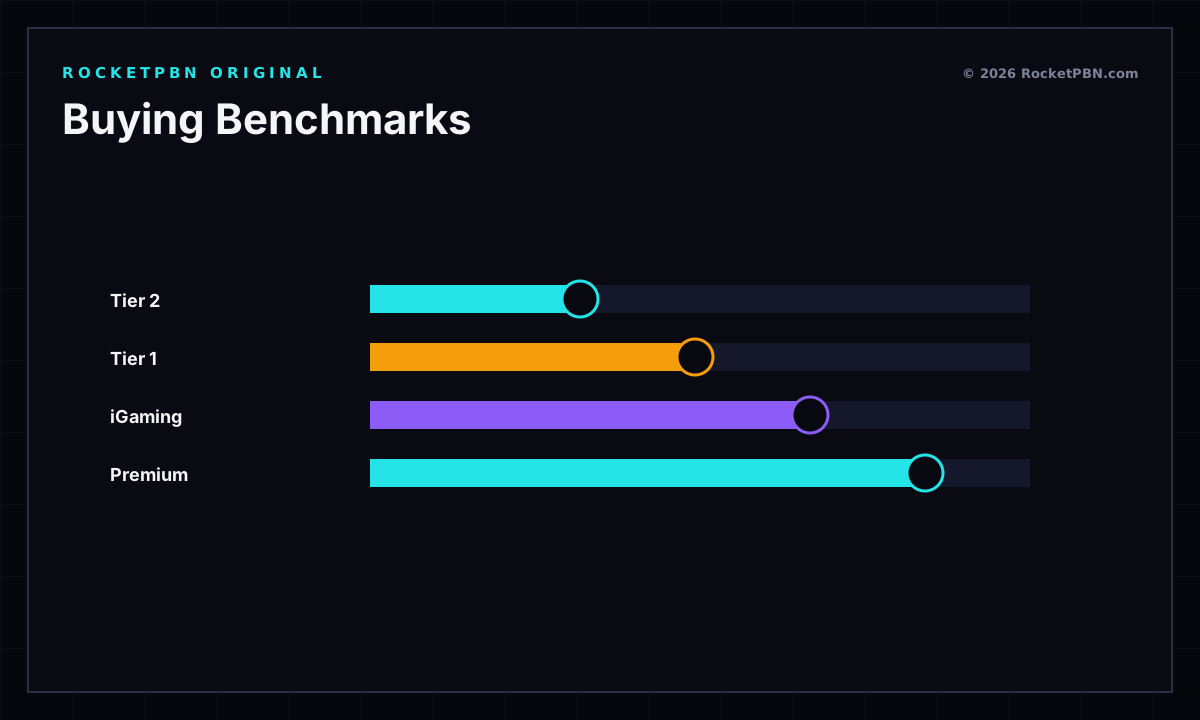
| Use case | DR | TF | TF:CF | Referring domains | Topical fit |
|---|---|---|---|---|---|
| Tier 2 support | 20+ | 10+ | 0.35+ | 10+ | adjacent allowed |
| Tier 1 PBN | 35+ | 15+ | 0.50+ | 20+ | matching preferred |
| iGaming tier 1 | 40+ | 20+ | 0.55+ | 25+ | Gambling/Sports/Games |
| Premium asset | 50+ | 25+ | 0.60+ | 40+ | dominant match |
These are starting points, not guarantees. A domain below the benchmark can still work if it has unusually clean links. A domain above the benchmark can still fail if history is dirty.
Manual Review Sequence
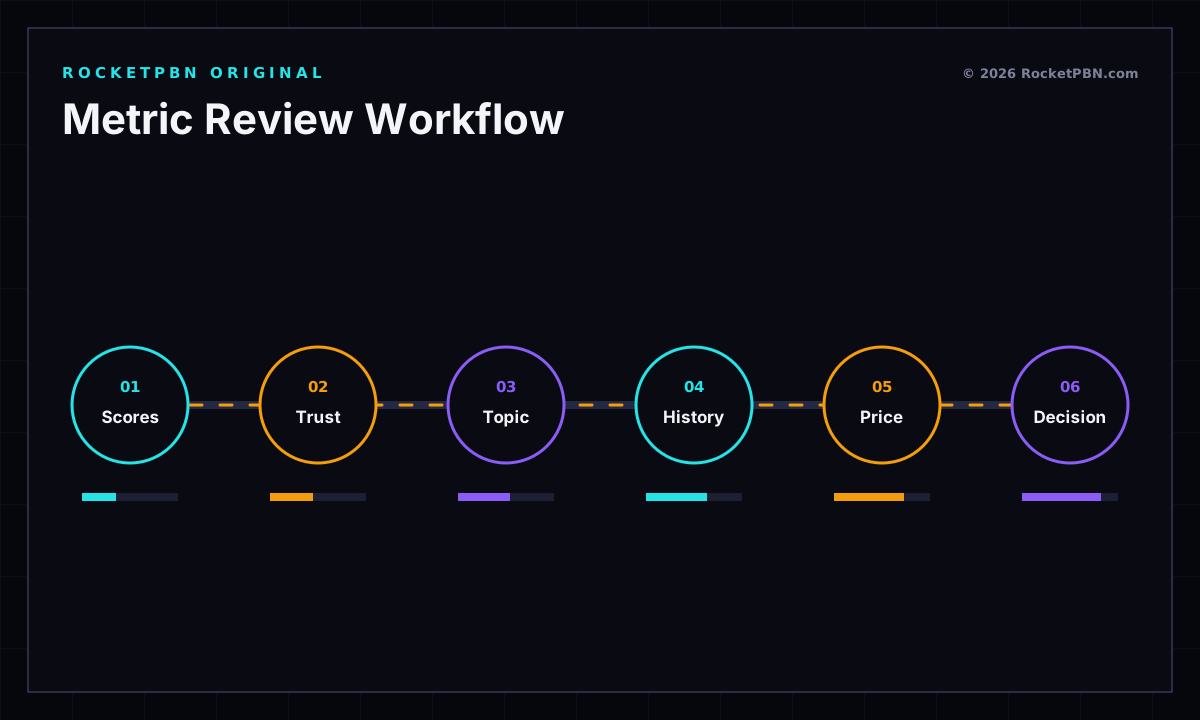
- Check DR, DA, TF, CF, referring domains, and topical category.
- Open the top 20-50 referring domains.
- Review anchor text for commercial or foreign-language pollution.
- Check Wayback for at least two years of relevant content.
- Search the domain in Google for indexed traces.
- Compare price with deployable use case.
What Makes a Domain Buyable
A buyable domain has consistent evidence: authority scores make sense, trust is not far below volume, topical category matches the campaign, history explains the backlinks, anchors are natural, and price fits the intended tier.
For the complete purchase workflow, use Expired Domains for SEO.
What Metric Patterns Should Make You Reject a Domain?
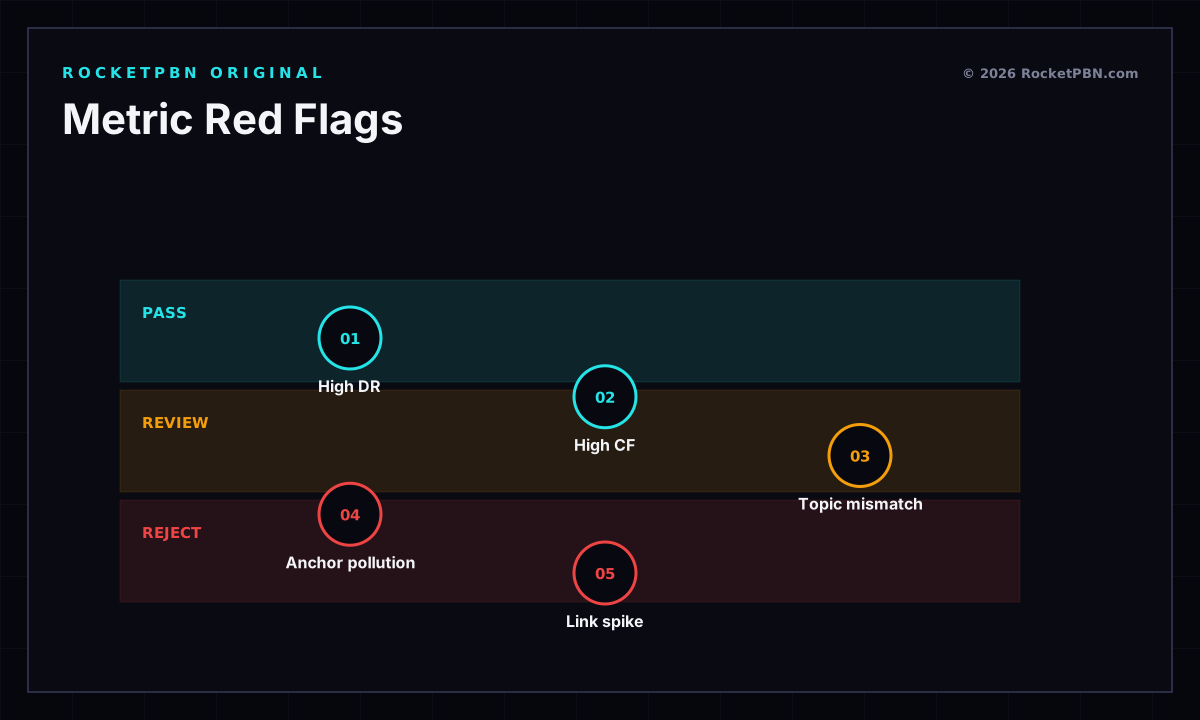
Reject a domain when metrics diverge sharply, trust is far below link volume, topical categories do not match history, anchors show commercial pollution, or authority appears after a suspicious link spike. Metric contradictions usually reveal the real risk.
Common Red Flags
| Pattern | Likely issue | Action |
|---|---|---|
| High DR, low RD count | inflated links | review top backlinks |
| High CF, low TF | link volume without trust | usually reject |
| Strong DA, weak traffic | model mismatch | inspect index status |
| Topical mismatch | niche flip | reject for tier 1 |
| Commercial anchors | previous manipulation | reject or discount |
| Sudden link spike | artificial campaign | wait or reject |
Why Metric Divergence Matters
Different tools see different link graphs. Some disagreement is normal. Severe disagreement is a signal. If Ahrefs shows strength, Moz is weak, Majestic trust is low, and Wayback is unrelated, the domain needs more proof before it deserves budget.
When To Discount Instead of Reject
Not every weakness kills the domain. Weak DA but strong TF, clean history, and matching topical trust can still be useful. Low DR but strong niche links can work for tier 2. Discount when the weakness affects price but not deployability. Reject when the weakness affects trust or topical continuity.
How Should Metrics Shape PBN Deployment?
Metrics should determine how aggressively a rebuilt domain is used. Strong topical trust and clean history can support tier 1 contextual links. Mixed signals require slower rebuilds, branded anchors, tier 2 use, or rejection.
Deployment Matrix
| Metric pattern | Rebuild plan | Anchor posture | Use |
|---|---|---|---|
| High TF, strong topical fit | same-topic rebuild | branded + partial | tier 1 |
| High DR, moderate TF | broader topical rebuild | branded first | cautious tier 1 |
| Low TF:CF ratio | content only or discard | no money anchors | reject/review |
| Weak topic match | bridge content | brand/URL only | tier 2 |
| Clean but small | lightweight rebuild | branded | support site |
Why Rebuild Context Matters
Expired-domain metrics were earned by the old site. If the rebuild ignores that context, the link graph becomes harder to explain. A sports history should become a sports or betting-adjacent property. A finance history should not become a casino review site without a credible bridge.
How To Monitor After Deployment
Track indexing, crawl frequency, impressions, money-page movement, and link profile changes. If the rebuilt domain fails to index or loses visible trust signals, pause outbound linking. Metrics at purchase time are only the starting condition.
For infrastructure and link timing, read How to Build a PBN.
How Do Metrics Fit Into a GEO and AI Search Strategy?
Domain metrics help GEO indirectly by identifying sources with stronger link graphs, cleaner trust signals, and better topical authority. AI answer engines still need crawlable, structured, factual content; metrics alone do not create citations.
Authority Supports Retrieval, But Structure Wins Citations
For AI answer engines, a strong domain can help a page get crawled and trusted, but the page still needs extractable answers. Use question headings, concise definitions, tables, schema, and source notes so the answer engine can retrieve and cite the content.
Metrics for Source Selection
When building citations, partnerships, or PBN support pages, choose sources that combine authority and relevance. A DR 70 general directory is weaker for GEO than a DR 35 niche publication with clean topical coverage and clear entity mentions.
What To Track
Track inclusion rate, citation rate, top-of-answer visibility, branded search lift, and direct traffic spikes. If a page earns links but never appears in AI answers, improve chunk structure, schema, definitions, and factual density before buying more links.
Frequently Asked Questions
Is Domain Authority a Google ranking factor?
No. Domain Authority is a Moz metric, not a Google ranking factor. Google has its own ranking systems and link analysis systems. DA can still be useful as a comparative SEO tool, but it should not be treated as something Google reads or rewards directly.
Is DR better than DA?
DR is better for reading backlink-profile strength in Ahrefs. DA is better for getting Moz's ranking-potential estimate. Neither is universally better. Use DR, DA, TF, CF, topical fit, referring domains, traffic, anchors, and history together.
What is a good Trust Flow score?
For expired-domain buying, TF 15+ is a useful minimum for many tier 1 candidates, while TF 20+ is stronger. TF below 10 is usually weak unless the domain has exceptional topical relevance or brand value. Always compare TF against CF.
What TF:CF ratio should you target?
A TF:CF ratio above 0.50 is a practical minimum for many expired-domain purchases. Above 0.70 is stronger. Below 0.30 usually means link volume is not supported by trust and should trigger rejection or deep manual review.
Can domain metrics be manipulated?
Yes. Any third-party metric can be influenced by links that the tool sees. That is why operators inspect backlink sources, anchor text, Wayback history, index status, traffic, and topical fit before buying. The best protection is cross-tool agreement plus manual review.
Related Reading
- Expired Domains for SEO
- What Is Topical Trust Flow?
- SpamZilla Complete Guide
- How to Build a PBN
- Browse pre-vetted aged domains ->
Source Notes
This guide uses official documentation from Ahrefs on Domain Rating, Moz on Domain Authority, Majestic on Trust Flow, Citation Flow, and Topical Trust Flow, and Google Search Central on ranking systems and link analysis.