How to Find Expired Domains in 2026: 7 Methods Ranked
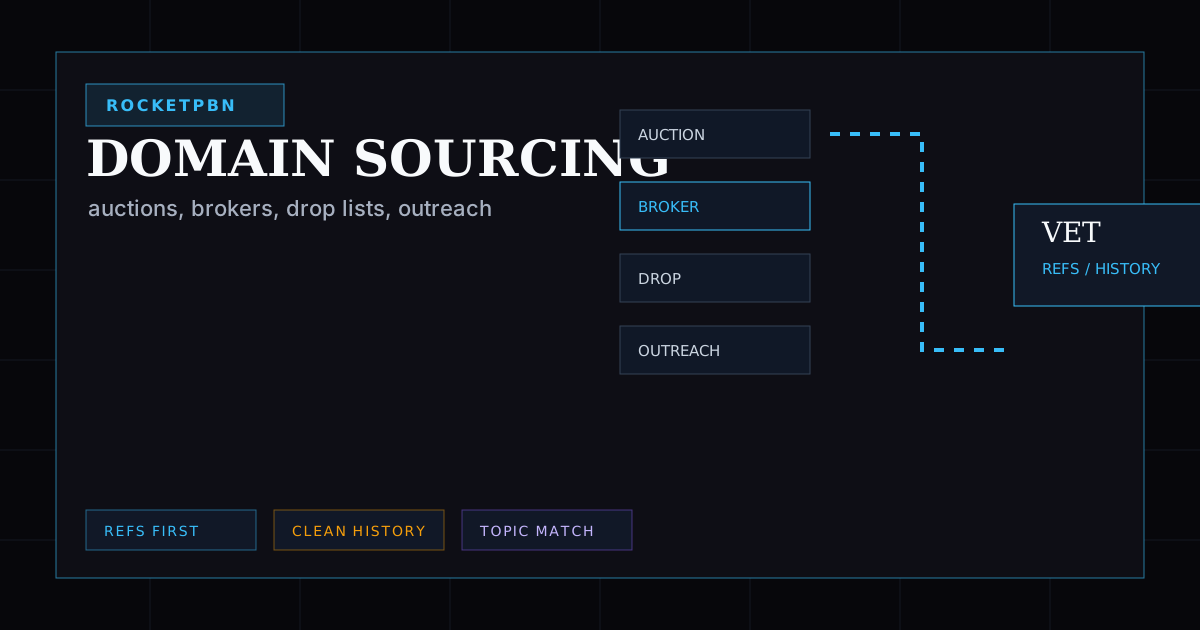
How to Find Expired Domains in 2026: 7 Methods Ranked
Finding expired domains is not about finding the biggest DR number in a drop list. It is about finding domains whose referring domains, old topic, anchor profile, and rebuild path still make sense. A domain with fewer but cleaner editorial backlinks can be more useful than a higher-metric domain with weak or unrelated links.
The best operators use a two-stage process. First, they gather candidates from auctions, drop lists, tools, and outreach. Then they reject most of them. The rejection step is where the money is saved. A raw list of 500 expired domains is not an inventory. It is a pile of unverified possibilities.
This guide ranks seven methods for finding expired domains, explains which methods produce the strongest referring-domain profiles, and gives a practical workflow for moving from discovery to vetting before buying.
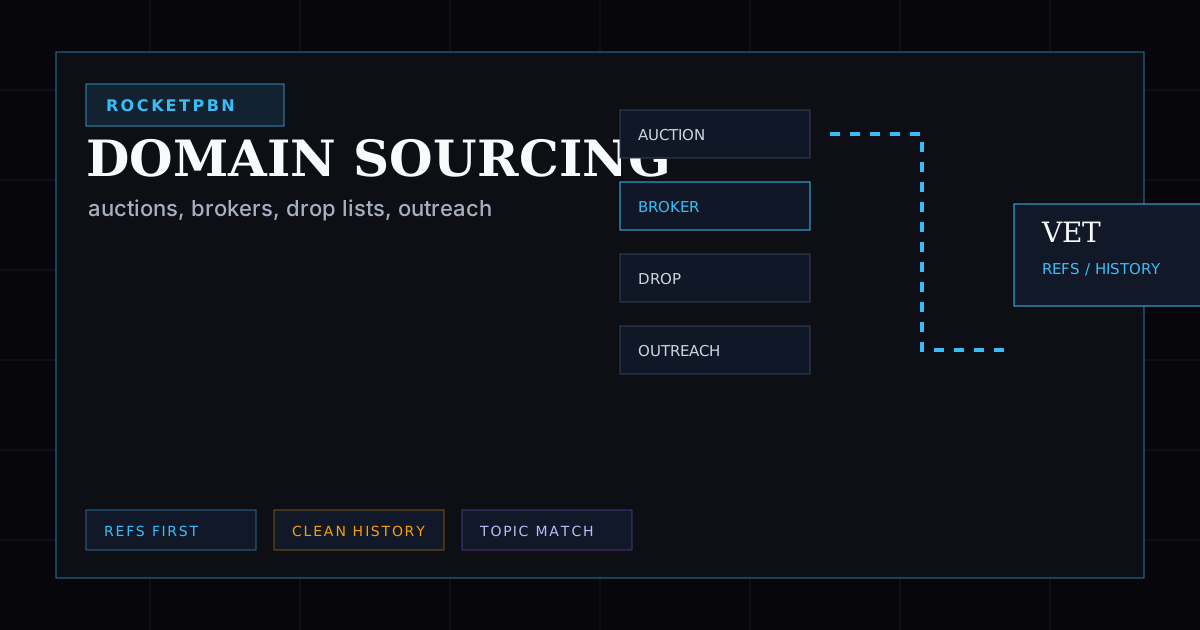
What Is the Fastest Way to Find Expired Domains Worth Buying?
The fastest way to find expired domains worth buying is to combine filtered discovery with manual backlink validation. Use auctions, SpamZilla, DomCop, or ExpiredDomains.net to generate candidates, then approve only domains with live referring domains, clean anchors, relevant history, and usable topical context.
Discovery Is Not Approval
Discovery tools answer: "What domains might be available?"
Evaluation answers: "Is this domain worth money?"
Do not merge those questions. A domain can appear in an expired-domain list with age, metrics, and a clean-looking name while still failing on live links, Wayback history, anchor text, or topical fit.
The Fastest Practical Workflow
| Step | Action | Goal |
|---|---|---|
| 1 | Filter candidates by age, niche words, refs, and basic metrics | reduce noise |
| 2 | Check Ahrefs or similar backlink tool | validate referring domains and anchors |
| 3 | Check Majestic | validate Trust Flow and topical fit |
| 4 | Check Wayback | validate old topic and continuity |
| 5 | Open top referring pages | confirm links are live and editorial |
| 6 | Price against deployable value | avoid paying for vanity metrics |
The workflow is fast because it rejects weak domains early.
What Makes a Candidate Worth Reviewing?
A candidate deserves review when it has:
- Enough live referring domains for the campaign role.
- Some editorial or topical links, not only directories.
- A previous topic that can support the rebuild.
- No obvious toxic anchors.
- Acceptable Trust Flow and TF:CF.
- A price that leaves room for risk.
If a domain only has an attractive name or one headline metric, keep moving.
How Do Auction Platforms Compare With Drop Lists?
Auction platforms usually provide stronger aged-domain candidates with market competition, while drop lists provide larger volume with lower average quality. Auctions are better for buyers who can vet quickly under time pressure. Drop lists are better for operators who can process many weak candidates cheaply.
Auction Platforms
GoDaddy Auctions, NameJet, Sedo, SnapNames, and DropCatch can surface good domains before or during the drop cycle. The advantage is access to domains other buyers also recognize as valuable. The disadvantage is price pressure and short decision windows.
Auction platforms work best when you have a checklist ready before bidding:
- Referring domains.
- Trust Flow and TF:CF.
- Topical Trust Flow.
- Anchor profile.
- Wayback history.
- Live top links.
- Index and reputation checks.
- Maximum bid.
Without that process, auctions can turn into emotional bidding on incomplete data.
Drop Lists
Drop lists are broader and noisier. ExpiredDomains.net, DomCop, SpamZilla, and similar tools can show thousands of candidates. Most will fail. The value comes from filtering efficiently.
Drop lists are useful when:
- You are building a long-term inventory.
- You can reject candidates quickly.
- You are looking for niche-specific histories.
- You have time to wait for underpriced assets.
Auction vs Drop List
| Source | Candidate quality | Cost | Time pressure | Vetting burden |
|---|---|---|---|---|
| Auctions | medium to high | medium to high | high | high |
| Drop lists | low to medium | low to medium | medium | very high |
| Broker shortlist | medium to high | medium to high | low | lower |
For buyers who need speed, Where to Buy Aged Domains explains when a broker or pre-vetted marketplace is more efficient.
How Should SpamZilla and DomCop Filters Be Used?
SpamZilla and DomCop filters should be used to reduce candidate volume, not to approve purchases. Start with broad filters for age, referring domains, Trust Flow, language, TLD, and spam signals, then manually verify backlinks, anchors, Wayback history, and topical fit.
Starter Filter Set
Use filters as a first pass:
| Filter | Starting point | Why |
|---|---|---|
| Domain age | 3+ years | avoids very thin histories |
| Referring domains | 15+ | avoids empty profiles |
| Trust Flow | 10+ | screens some low-quality volume |
| TF:CF ratio | 0.4+ | reduces obvious spam volume |
| TLD | .com / relevant ccTLD | aligns with campaign |
| Language | target market language | reduces geo mismatch |
| Spam signals | low or explainable | avoids obvious rejects |
Do not set filters so tight that you miss good topical assets. A domain with modest metrics but strong niche refs can be worth review.
Use Niche Keywords
For restricted-niche or sports campaigns, search old domain names and metadata for terms such as:
- Sports.
- Football.
- Racing.
- Poker.
- review-site.
- Odds.
- regulated.
- Tips.
- Games.
- Esports.
Then verify with Wayback and backlinks. The keyword in the domain name is not enough.
Batch Review
Export a shortlist and batch it through Ahrefs or another backlink tool. Sort by live referring domains first, not DR first. Then use Majestic for Trust Flow and Topical Trust Flow. This keeps the workflow aligned with deployable backlink strength.
How Can Ahrefs Reveal Expired Domain Opportunities?
Ahrefs can reveal expired-domain opportunities through broken-link research, competitor lost links, referring-domain analysis, top-page decay, and anchor review. Its best role is validating referring domains and link quality after discovery, not replacing history and trust checks.
Broken Link Research
Find pages in your niche that attracted links and now return errors or no longer maintain the original content. If the root domain or related domain has expired or is available, it may become a candidate.
Useful angles:
- Old sports blogs.
- Defunct local news sites.
- Closed event websites.
- Former poker or gaming communities.
- Old tools or calculators.
- Resource pages with dead outbound links.
The domain still needs ownership and history checks before purchase.
Competitor Link Decay
Review competitor backlink profiles and look for domains that used to link to them but no longer resolve, changed topic, or dropped. This can reveal old niche sites with link history.
The value is topical relevance. A domain discovered through a competitor's old link graph is more likely to belong to the same niche than a random drop-list candidate.
What to Check in Ahrefs
| Ahrefs area | What to inspect |
|---|---|
| Referring domains | live quality and source relevance |
| Anchors | toxic or commercial contamination |
| New/lost links | spikes, drops, seller-built links |
| Best by links | old pages that earned authority |
| Outgoing links | link farm or seller pattern |
| Organic pages | whether the domain had real visibility |
Ahrefs tells you where to look. It does not approve the domain alone.
When Does Manual Outreach Make Sense?
Manual outreach makes sense when you want a unique aged domain that has not entered public auction competition. It works best for dormant niche sites, old blogs, closed communities, local publications, event sites, and owners who no longer maintain the domain.
Outreach Targets
Look for:
- Sites with old posts but no recent updates.
- Niche blogs with broken contact forms but active ownership.
- Local sports or event sites after the season ended.
- Old affiliate sites no longer monetized.
- Small publications with strong historical links.
- Domains with valuable backlinks but weak current operations.
These are not technically expired yet, but they can become acquisition opportunities.
Outreach Pros and Cons
| Advantage | Limitation |
|---|---|
| less public competition | slow negotiation |
| better chance of unique topical history | owner may overprice |
| can inspect live site before transfer | legal/ownership checks needed |
| may include content or redirects | requires relationship work |
Manual outreach is not scalable in the same way drop lists are. It is useful when one strong topical domain is worth more than a hundred weak candidates.
Due Diligence Still Applies
Do not skip vetting because the domain is live. Check links, anchors, history, index status, content ownership, trademarks, and transfer process. A live site can still have a contaminated backlink profile.
What Should Happen After a Candidate Is Found?
After a candidate is found, it should move through a strict evaluation checklist before purchase. Review live referring domains, Trust Flow, TF:CF, Topical Trust Flow, anchors, Wayback history, index signals, outbound links, language fit, and price. Most candidates should be rejected.
Candidate Approval Checklist
| Check | Pass signal |
|---|---|
| Live referring domains | real pages still link to the domain |
| Ref quality | editorial, topical, not only directories |
| Trust Flow | acceptable for campaign role |
| TF:CF ratio | not volume-heavy without trust |
| Topical TF | direct or adjacent fit |
| Anchors | no toxic concentration |
| Wayback | continuous or explainable history |
| Index signals | no obvious deindex issue |
| Outbound profile | no link-farm pattern |
| Price | justified by deployable value |
For the full process, use the Expired Domain Evaluation Checklist.
Buy, Watch, or Reject
| Decision | When |
|---|---|
| Buy | refs, history, topic, anchors, and price align |
| Watch | promising but price is high or data is incomplete |
| Reject | history, anchors, trust, or live refs fail |
Do not build a portfolio from "watch" domains just because they are cheap. Cheap weak domains create hosting and content costs without useful authority.
Build the Rebuild Plan Before Paying
Before buying, answer:
- What was this domain historically?
- What content can be rebuilt naturally?
- Which campaign will it support?
- What anchors can it justify?
- What is the maximum price after risk?
If those answers are unclear, the domain is not ready.
What Questions Do Buyers Ask About Finding Expired Domains?
Can free tools find good expired domains?
Yes, but free workflows require more manual labor. ExpiredDomains.net and Wayback can surface candidates, but serious buying still needs backlink and trust validation from tools such as Ahrefs, Majestic, or equivalent data sources.
Should I sort expired domains by DR?
No. DR can help with rough filtering, but sorting only by DR pushes buyers toward vanity metrics. Sort by usable referring domains, topical fit, Trust Flow, anchor cleanliness, and history.
How many candidates should I review before buying one?
Expect a low hit rate. A raw list of 100 filtered domains may produce 5-15 deeper reviews and 0-3 buys. If every candidate looks good, your filters are probably too loose.
Is a dropped domain weaker than an aged domain bought from an owner?
Not automatically. The value depends on whether the links, history, and topical context survived. A dropped domain with live editorial refs can be useful. A privately sold aged domain with polluted anchors can be a bad buy.
What Should You Read Next?
- Where to Buy Aged Domains
- Expired Domain Evaluation Checklist
- Best Expired Domain Tools
- Domain Authority Metrics Explained
- Browse backlink-led aged domain inventory ->
Which Sources Inform This Guide?
Tool sections should be refreshed against current Ahrefs, Majestic, SpamZilla, DomCop, ExpiredDomains.net, and Wayback documentation. Policy-sensitive sections reference Google Search Central documentation on spam policies, expired domain abuse, link spam, and qualifying paid or sponsored links.