Link Profile Analysis: Turning Backlink Data Into a Buy or Reject Decision
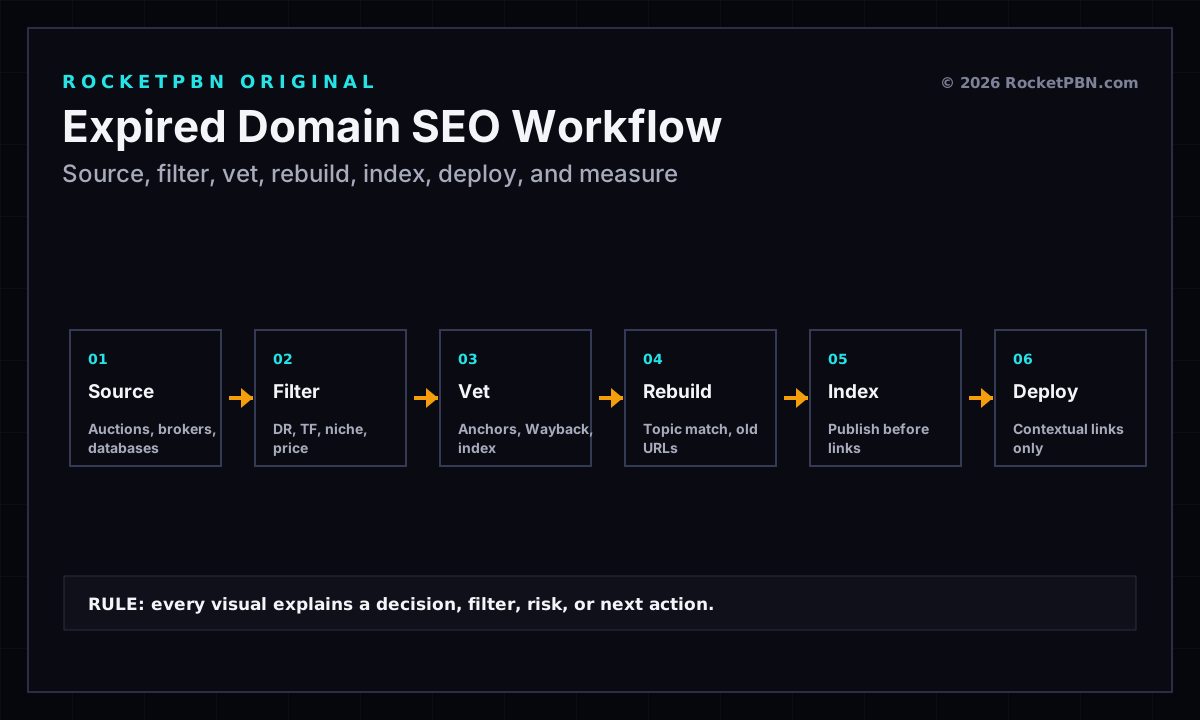
Link Profile Analysis: Turning Backlink Data Into a Buy or Reject Decision
Link profile analysis is where a domain stops being a spreadsheet row. The question is not “how many links?” It is whether the best links are real, relevant, live, and connected to a history you can still use.
This guide is written for operators who need a purchase or deployment decision, not a generic definition. The working question is simple: does the evidence support the way this asset will be used?
Who this is for
Use this workflow when you are trying to make a practical decision: buyer converting backlink reports into a domain purchase decision. The useful answer has to cover the evidence to inspect, the mistakes to avoid, and the next action after the review.
Build a short list of links that actually matter
Review the strongest 20 to 50 referring domains manually. Remove dead, duplicated, no-context, and obviously generated links from your mental valuation. The purchase case should still make sense after weak links are ignored.
Connect every strong link to a reason
A strong referring domain should have a visible reason for linking: an old resource, brand mention, tool, event, quote, statistic, or local reference. If the reason is invisible, the link is less stable.
Use anchors to detect the real use case
Brand and URL anchors usually support a rebuild. Topical anchors can support content expansion. Repeated money anchors often mean the domain was already used as an SEO asset and deserves more skepticism.
Turn analysis into price
Pay more when the best links are relevant, live, editorial, and easy to support with content. Pay less or walk away when the value depends on fragile links, unclear history, or a deployment plan that requires forcing the topic.
Field checklist before you act
Use this short checklist before you spend money, add links, redirect pages, or change a live campaign:
- Review top links: editorial and relevant. Decision note: generated or unrelated.
- Review anchors: brand and natural phrases. Decision note: repeated commercial anchors.
- Review old urls: can be rebuilt or mapped. Decision note: no page-level context.
- Review velocity: explained by real activity. Decision note: sudden unexplained spike.
The checklist should be saved with the domain or campaign record. A decision that cannot be written down clearly usually means the evidence is not clear enough yet. For aged domains, that matters because the expensive mistakes rarely come from one bad metric. They come from several small assumptions that were never checked together.
Mistakes that make this decision expensive
The first mistake is treating tool output as proof. Metrics, crawlers, and reports are useful starting points, but they do not replace opening the strongest pages and reading the old site history. If the best evidence cannot survive manual review, the domain or campaign is not ready.
The second mistake is moving too quickly after a purchase. Aged assets need context before pressure. Rebuild the pages that explain the old links, publish enough supporting content to make the site coherent, and measure crawl or index changes before adding more commercial intent.
The third mistake is ignoring topic distance. A domain can be strong and still be wrong for the campaign. If the old sources, old content, anchor language, and new destination cannot be connected in one plain-English explanation, the deployment path is weak.
Buy or reject scoring
| Factor | Buy signal | Reject signal |
|---|---|---|
| Top links | Editorial and relevant | Generated or unrelated |
| Anchors | Brand and natural phrases | Repeated commercial anchors |
| Old URLs | Can be rebuilt or mapped | No page-level context |
| Velocity | Explained by real activity | Sudden unexplained spike |
Common questions
Is link profile analysis different from backlink checking?
Yes. Backlink checking collects data; link profile analysis decides what the data means for a real purchase.
What is the most common mistake?
Counting all links equally instead of valuing only the links that are live, relevant, and explainable.
Next step
If you are reviewing aged domains for a live campaign, compare the evidence against related RocketPBN guides before you open inventory:
- How to read a backlink profile
- Spam score checks
- Expired domain metrics checklist
- Browse pre-vetted aged domains
Browse RocketPBN only after the quality standard is clear. The goal is not to buy the oldest domain or the highest metric; it is to buy an asset whose history, links, and deployment path still make sense.