Domain Flip ROI Analysis: Price the Risk Before You Chase the Multiple
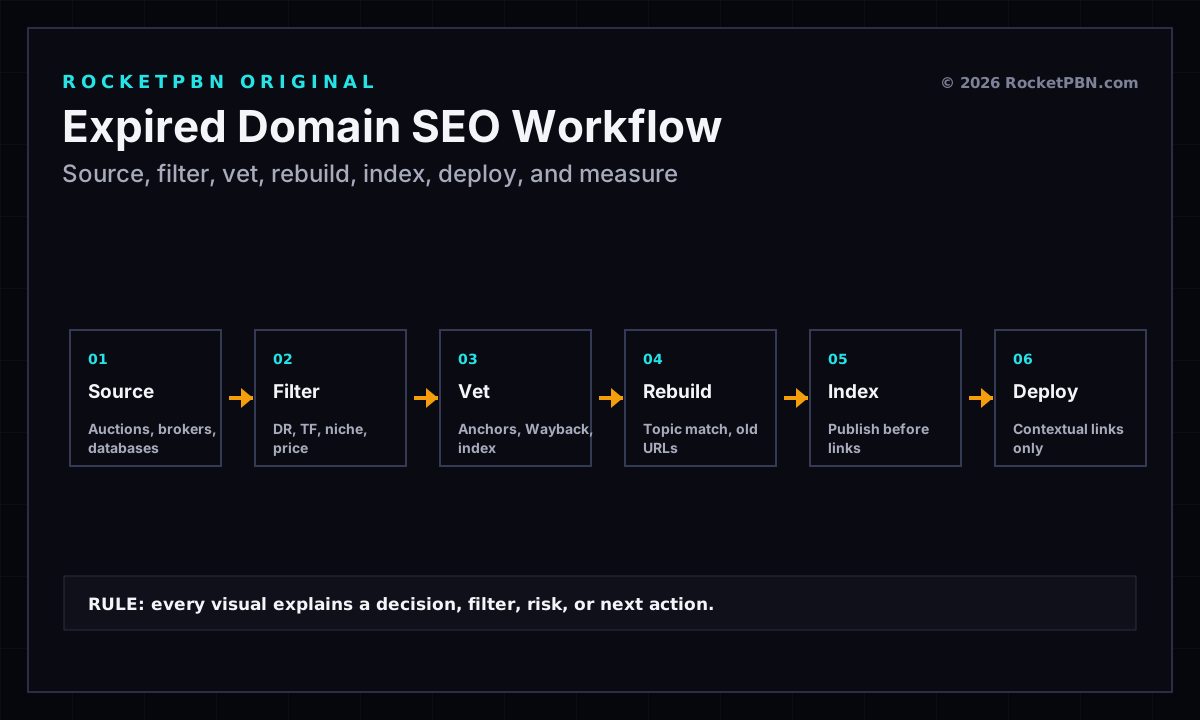
Domain Flip ROI Analysis: Price the Risk Before You Chase the Multiple
Domain flipping looks simple only when the spreadsheet ignores risk. Real ROI depends on acquisition price, verification time, holding cost, rebuild cost, buyer demand, and the chance that the backlink value does not survive inspection.
This guide is written for operators who need a purchase or deployment decision, not a generic definition. The working question is simple: does the evidence support the way this asset will be used?
Who this is for
Use this workflow when you are trying to make a practical decision: buyer or seller calculating whether an aged-domain flip has enough margin. The useful answer has to cover the evidence to inspect, the mistakes to avoid, and the next action after the review.
Start with total cost, not winning bid
The purchase price is only one line. Add auction fees, renewal, research time, content rebuild, tools, escrow, opportunity cost, and the cost of domains that fail review. A profitable flip has to cover the misses too.
Value the domain by buyer use case
A domain with sports links may be valuable to a sportsbook affiliate, less valuable to a software company, and useless to a casino page if the history does not connect. The highest buyer is usually the one with the clearest deployment path.
Discount uncertain evidence
Dead links, unclear archives, risky anchors, trademark issues, and niche mismatch should lower the expected resale value. Do not price a domain as clean when the buyer will discover the same problems.
Set a stop-loss before renewal cycles
If a domain cannot attract qualified interest or cannot pass deeper review, holding it longer may only compound cost. Decide before purchase whether the plan is quick resale, rebuild, lease, or drop.
Field checklist before you act
Use this short checklist before you spend money, add links, redirect pages, or change a live campaign:
- Review acquisition price: bought below evidence value. Decision note: auction overbid.
- Review verification: clear history and live links. Decision note: uncertain or conflicting data.
- Review buyer fit: specific niche demand. Decision note: generic buyer story.
- Review holding time: fast qualified sale. Decision note: renewals without plan.
The checklist should be saved with the domain or campaign record. A decision that cannot be written down clearly usually means the evidence is not clear enough yet. For aged domains, that matters because the expensive mistakes rarely come from one bad metric. They come from several small assumptions that were never checked together.
Mistakes that make this decision expensive
The first mistake is treating tool output as proof. Metrics, crawlers, and reports are useful starting points, but they do not replace opening the strongest pages and reading the old site history. If the best evidence cannot survive manual review, the domain or campaign is not ready.
The second mistake is moving too quickly after a purchase. Aged assets need context before pressure. Rebuild the pages that explain the old links, publish enough supporting content to make the site coherent, and measure crawl or index changes before adding more commercial intent.
The third mistake is ignoring topic distance. A domain can be strong and still be wrong for the campaign. If the old sources, old content, anchor language, and new destination cannot be connected in one plain-English explanation, the deployment path is weak.
ROI model
| Cost or value driver | Improves ROI | Hurts ROI |
|---|---|---|
| Acquisition price | Bought below evidence value | Auction overbid |
| Verification | Clear history and live links | Uncertain or conflicting data |
| Buyer fit | Specific niche demand | Generic buyer story |
| Holding time | Fast qualified sale | Renewals without plan |
Common questions
What is a good ROI for a domain flip?
It depends on risk and holding time. A smaller reliable margin can beat a large theoretical multiple with low liquidity.
Should I rebuild before selling?
Rebuilding can raise confidence when it restores context, but it also adds cost. Do it only when the buyer value increases more than the work required.
Next step
If you are reviewing aged domains for a live campaign, compare the evidence against related RocketPBN guides before you open inventory:
- Where to buy aged domains
- Domain history check workflow
- Expired domain tools comparison
- Browse pre-vetted aged domains
Browse RocketPBN only after the quality standard is clear. The goal is not to buy the oldest domain or the highest metric; it is to buy an asset whose history, links, and deployment path still make sense.